Fighting Inflation at the Checkout
You’ve felt it every week at the grocery store. The same cart that cost $120 two years ago now rings up at $160. Eggs, milk, bread, produce—nothing escaped the price surge, and your paycheck certainly didn’t keep pace. While you can’t control inflation, you can control how much of your actual money goes toward feeding your family.
Here’s the budget hack that’s gaining traction among financially savvy shoppers: earning free Walmart gift cards through legitimate reward programs, then dedicating those cards exclusively to groceries. When you cover $50-100 of your monthly grocery bill with earned cards instead of your paycheck, you’ve effectively given yourself a raise without asking your boss.
This isn’t about extreme couponing or switching to off-brand everything. It’s about redirecting your existing downtime—scrolling social media, playing mobile games, watching videos—into earning power that directly offsets your biggest recurring expense. Walmart gift cards work on groceries, household essentials, pharmacy items, and even gas at Walmart fuel stations, making them the most practical card for budget-conscious families.
Let’s break down the legitimate methods that actually deliver results, ranked by speed and ease.
The Best Way to Subsidize Your Grocery Bill
Earning with GiftCards Daily: The Utility-First Strategy
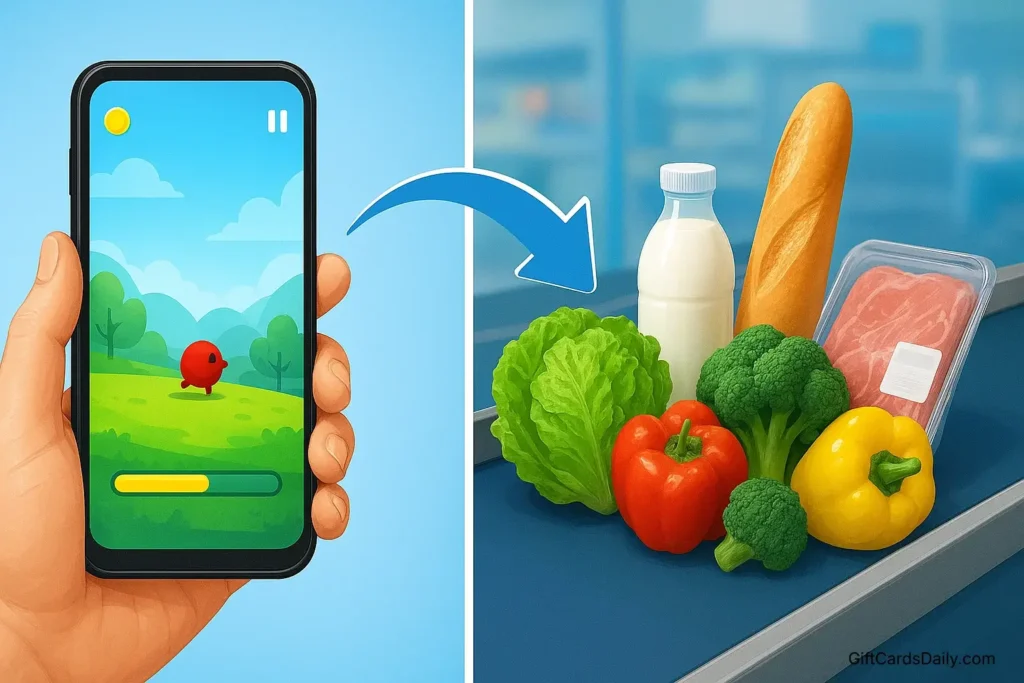
The premise: Instead of mindlessly scrolling during your lunch break or waiting in school pickup lines, you could be converting that phone time into grocery money. GiftCards Daily operates on this simple utility principle—your attention has value to advertisers, and they’ll compensate you in Walmart gift cards to capture it.
How it subsidizes real grocery costs: Let’s do practical math. Your family spends roughly $600 monthly on groceries. If you dedicate 30-45 minutes daily to completing offers on GiftCards Daily, you’ll typically earn $60-80 monthly in gift cards. You choose Walmart as your redemption target. Suddenly, you’ve covered 10-13% of your grocery bill without cutting a single item from your shopping list.
The weekly breakdown: Most families shop groceries weekly, spending around $140-150 per trip. Earning a $25 Walmart card every 10 days through consistent reward app use means every third or fourth grocery trip becomes significantly cheaper. That’s the difference between stressing over whether you can afford the good yogurt or just buying it.
Best earning strategies for grocery-focused users:
- Morning routine (10 minutes): While drinking your coffee, complete 2-3 quick surveys or watch video ad series. This typically earns 200-400 points before you even leave for work.
- Commute time (15 minutes): If you take public transit or have a passenger commute, tackle app installation offers, which pay 300-800 points for trying new games or utility apps for just a few minutes.
- Evening wind-down (20 minutes): After kids are in bed or during your TV time, run through daily bonuses and any featured offers you missed. This is when you’ll hit 600-1,000 points daily.
The compounding effect: Stay consistent for 10 days, and you’ll have your first $10-15 Walmart redemption ready. Use it immediately on your next grocery run to feel the psychological win of “free groceries.” That positive reinforcement makes it easier to maintain the habit, which compounds your monthly savings.
📲 Download GiftCards Daily (Rated 4.8/5.0 by users) and start earning toward your next grocery trip today.
Why Walmart cards specifically: Walmart operates the largest grocery network in America, making your earned cards usable almost anywhere. Unlike specialty food stores, Walmart carries everything from organic produce to generic staples, meaning your gift cards stretch across your entire shopping list regardless of dietary preferences or budget tier.
Receipt Scanning Apps (The “Passive Stacking” Method)
Receipt scanning apps like Fetch Rewards and Ibotta offer a completely different earning model—they reward you for groceries you’re already buying rather than for completing tasks. After each shopping trip, you scan or upload your receipt through the app, which awards points based on featured products or total spending.
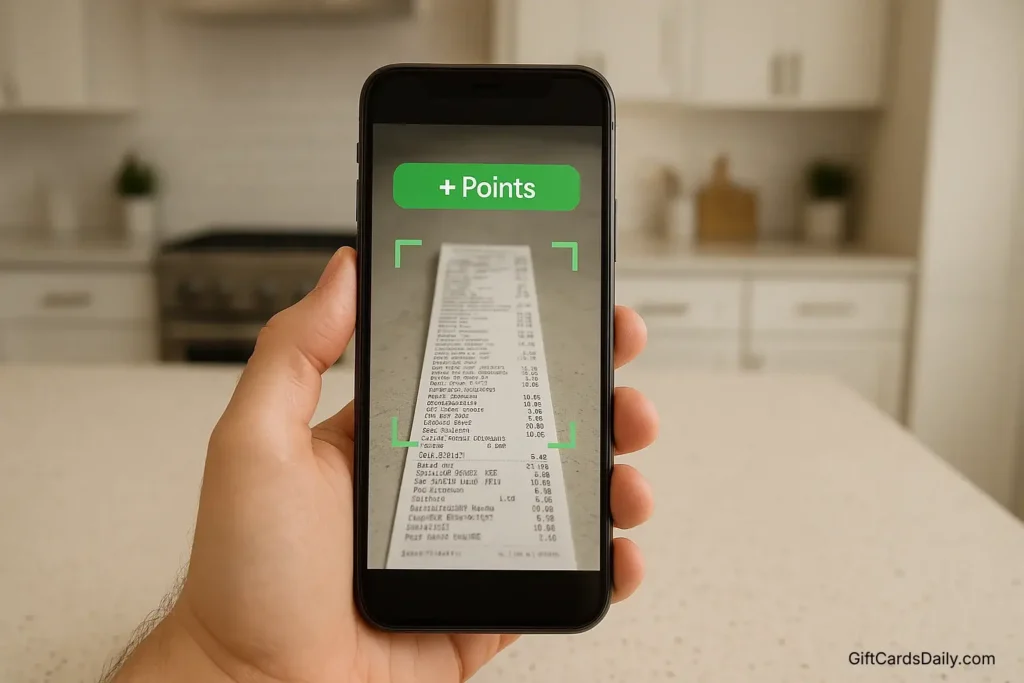
The honest earning timeline: Don’t expect miracles. Most families accumulate $10-15 monthly through receipt scanning apps after regular weekly grocery runs. Some months with bonus categories might push that to $20-25, but this is slow, passive income rather than active earning.
The strategic advantage—stacking: The beauty of receipt scanning apps is they work alongside GPT apps without competing for your time. You’re shopping anyway, so scanning receipts takes 30 seconds per trip. Meanwhile, you’re actively earning through GiftCards Daily during your spare time. Combined, you might earn $80 monthly from GPT apps plus $15 from receipts, totaling nearly $100 toward groceries.
Which apps work best for Walmart shoppers:
- Fetch Rewards: Accepts receipts from any grocery store including Walmart, awards points for specific brands (check the app before shopping to maximize), and redeems to Walmart gift cards starting at $3. The earning rate is slow but genuinely requires zero extra effort beyond scanning.
- Ibotta: Focuses on rebates for specific products. Browse the app before your shopping trip, activate offers on items you planned to buy anyway, then scan your receipt after checkout. Redemptions start at $20 and include Walmart gift card options.
The reality check: These apps will never be your primary earning source. Treat them as a passive bonus that accumulates in the background while you focus active effort on faster-paying GPT apps. Over a year, though, that “passive” $150-180 still buys several weeks of groceries.
Walmart’s Own Trade-In Program: “Gadget to Gift Cards”
The opportunity most people miss: Walmart operates a trade-in program similar to Amazon’s, accepting old electronics, phones, tablets, and gaming devices in exchange for immediate Walmart gift cards. That drawer full of outdated tech you’ve been meaning to deal with could convert into $50-150 in grocery money.
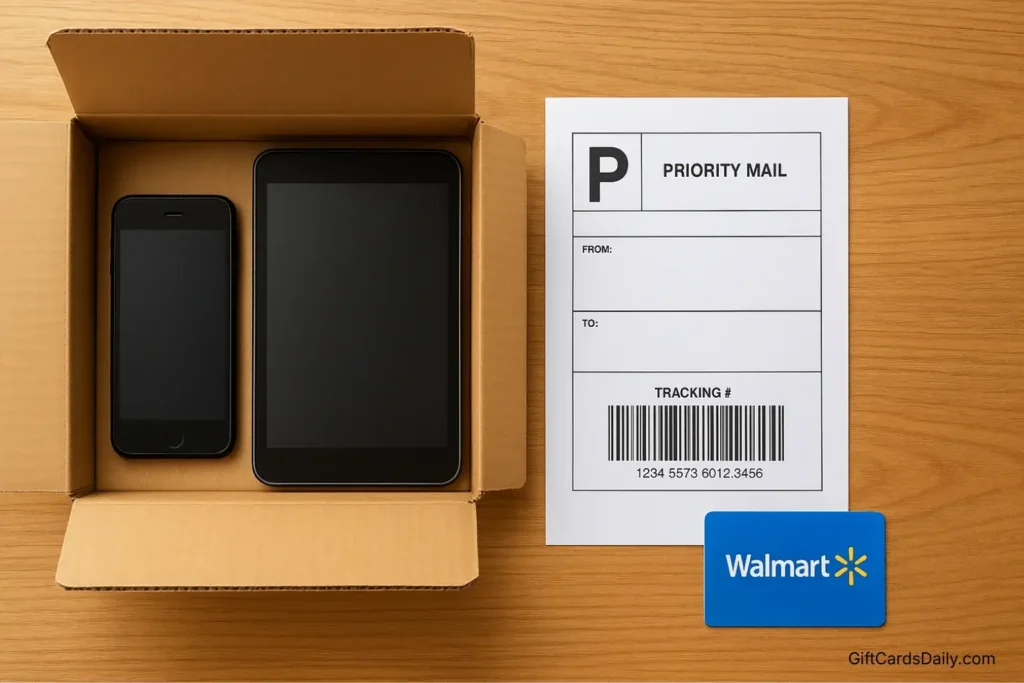
What qualifies: Smartphones from the past 5 years, tablets in working condition, video game consoles (even older generation), smartwatches, and certain laptops all have potential trade-in value. Walmart provides instant quotes through their online tool—just enter your device model and condition.
The process: Get your quote online, print the prepaid shipping label Walmart emails you, box up your device, drop it at any shipping location, and receive your Walmart gift card via email within 2-3 business days after their warehouse processes it. The entire timeline runs about one week from quote to usable card.
Strategic timing for maximum value: Clean out your tech annually rather than hoarding old devices until they’re worthless. Trading in your 3-year-old phone when you upgrade generates $40-80. Waiting until it’s 6 years old might drop that to $10-15. The depreciation curve is steep—act quickly after upgrading.
The one-time limitation: Like Amazon’s program, this is not recurring income. Once you’ve traded your old iPhone, iPad, and Xbox 360, you’re done until your next natural upgrade cycle. But that one-time $100-200 injection can cover 2-3 weeks of groceries, providing immediate budget relief while you build your ongoing GPT app earning habit.
🔗 Visit Walmart’s Gadget to Gift Cards program to check if your old electronics have trade-in value.
Safety Alert: “Walmart Mystery Shopper” Scams
Critical warning for your financial safety: If you receive an unsolicited email, text, or social media message claiming you’ve been selected as a Walmart mystery shopper, it’s a scam. This fraud scheme has cost victims thousands of dollars and relies on people’s desire to earn legitimate income.

How the scam works:
- Scammers contact you claiming you’ve been randomly selected for Walmart’s mystery shopper program.
- They send you a check (often $2,000-3,000) with instructions to deposit it and use the funds to “evaluate Walmart’s services.”
- You’re told to shop at Walmart, wire money via Western Union or MoneyGram as part of the “evaluation,” then keep $300-400 as your payment.
- You deposit the check, complete the assignment, wire the money, and keep your “payment.”
- Days later, your bank notifies you the check was fraudulent—you’re now responsible for the full amount you wired, plus bank fees.
Why it feels legitimate: The checks look real and initially clear your bank account because banks process deposits before verifying authenticity (which can take 5-10 days). Scammers exploit this verification window to convince you the funds are real before the fraud is discovered.
The financial damage: Victims lose whatever amount they wired (often $1,500-2,500) because that money is immediately unrecoverable once sent. Additionally, banks charge returned check fees and may close your account for depositing fraudulent checks, even if you were a victim. The total cost can exceed $3,000.
Red flags that always indicate scams:
- Unsolicited job offers you didn’t apply for.
- Checks sent before any work is performed.
- Instructions to wire money or buy gift cards as part of the “job.”
- Pressure to act quickly before “verifying” anything.
- Contact exclusively through email or text, never phone calls with verifiable company numbers.
Legitimate Walmart programs never: Send unsolicited checks, require you to wire money, ask you to evaluate wire transfer services, or contact you without your prior application to an official program.
For detailed information about mystery shopper scams and how to report them, visit the Federal Trade Commission’s consumer alert on mystery shopper fraud.
The takeaway: Real methods to earn Walmart gift cards require your time and attention, not handling large checks and wire transfers. If an opportunity sounds too good to be true or involves financial transactions before you’ve earned anything, it’s always a scam.
FAQ: Common Questions About Walmart Gift Cards
Can I use Walmart gift cards for gas?
Yes, with conditions. Walmart gift cards work at Walmart and Murphy USA fuel stations, which are often located at Walmart parking lots. Simply pay inside the station using your gift card, and the attendant will activate your pump. However, you typically cannot use gift cards at the pump itself—you must go inside to process the payment first.
This covers fuel costs but requires the extra step of going to the register rather than paying at the pump.
Can I buy alcohol or tobacco with Walmart gift cards?
Generally no. Walmart’s gift card terms prohibit using them for alcohol, tobacco, lottery tickets, or other age-restricted items in most states. This policy exists because gift cards can be owned by minors, and retailers can’t verify the cardholder’s age at checkout the same way they verify the purchaser’s age.
Stick to groceries, household items, clothing, electronics, pharmacy, and general merchandise where Walmart gift cards work universally.
How long do Walmart gift cards stay valid?
Walmart gift cards never expire, and balances don’t degrade over time. This is protected by federal law and Walmart’s terms of service. Once you redeem your earned points for a Walmart card and add it to your account (or carry the physical card), the value remains available indefinitely.
This makes them safe to accumulate over time if you want to save for a larger grocery haul or holiday shopping.
Can I combine multiple Walmart gift cards in one purchase?
Yes. Walmart allows you to use up to four gift cards per transaction when shopping in-store or online. If you’re accumulating smaller denomination cards ($5-10 each) from reward apps, you can stack them on a single grocery trip to maximize their impact.
For larger purchases, consider consolidating card balances onto your Walmart account online, which combines them into a single balance for easier management.
Do I need a Walmart+ membership to use gift cards?
No. Walmart gift cards work for all customers regardless of Walmart+ membership status. You’ll still benefit from all your earned cards even as a regular shopper. However, if you do have Walmart+, you can stack your gift cards with the program’s benefits like free shipping and fuel discounts for even better value—your earned cards cover the merchandise while Walmart+ covers the delivery cost.
Your Grocery Savings Action Plan
Stop letting inflation win every checkout. Here’s your step-by-step approach to subsidizing your grocery bill starting this week:
Week 1 Implementation:
- Download GiftCards Daily today and complete setup.
- Set a goal for your first $10 Walmart redemption (achievable in 7-10 days).
- Download Fetch Rewards or Ibotta and scan this week’s grocery receipts.
- Check Walmart’s trade-in program if you have old electronics gathering dust.
Week 2-4 Building Momentum:
- Maintain daily consistency on GiftCards Daily (30 minutes during existing downtime).
- Continue scanning all grocery receipts automatically.
- Hit your first redemption and use it immediately on groceries to feel the win.
- Calculate your monthly grocery spending to set realistic earning targets.
Monthly Optimization:
Track how much you’re offsetting monthly. Most consistent users cover $60-100 of their $600 grocery bill, effectively creating a 10-15% discount on food costs without cutting a single item from their cart. Over a year, that’s $720-1,200 in genuine savings that would otherwise come from your paycheck.
The psychological shift: The first time you checkout with a $25 earned gift card covering part of your grocery bill, something changes. You realize you’re not helpless against inflation—you’ve found a legitimate leverage point that puts money back in your pocket every single month.
📲 Download GiftCards Daily (Rated 4.8/5.0) and start earning toward your next grocery trip.
Prefer shopping at Target instead? 👉 Read our guide on earning free Target gift cards for similar strategies optimized for Target shoppers.
Want to compare all shopping gift card options? 👉 See our complete guide to the best shopping gift cards for a full breakdown of Amazon, Target, and specialty cards.
Last updated: December 2025. Grocery prices and reward app features may change. Always verify current redemption options before investing significant time.